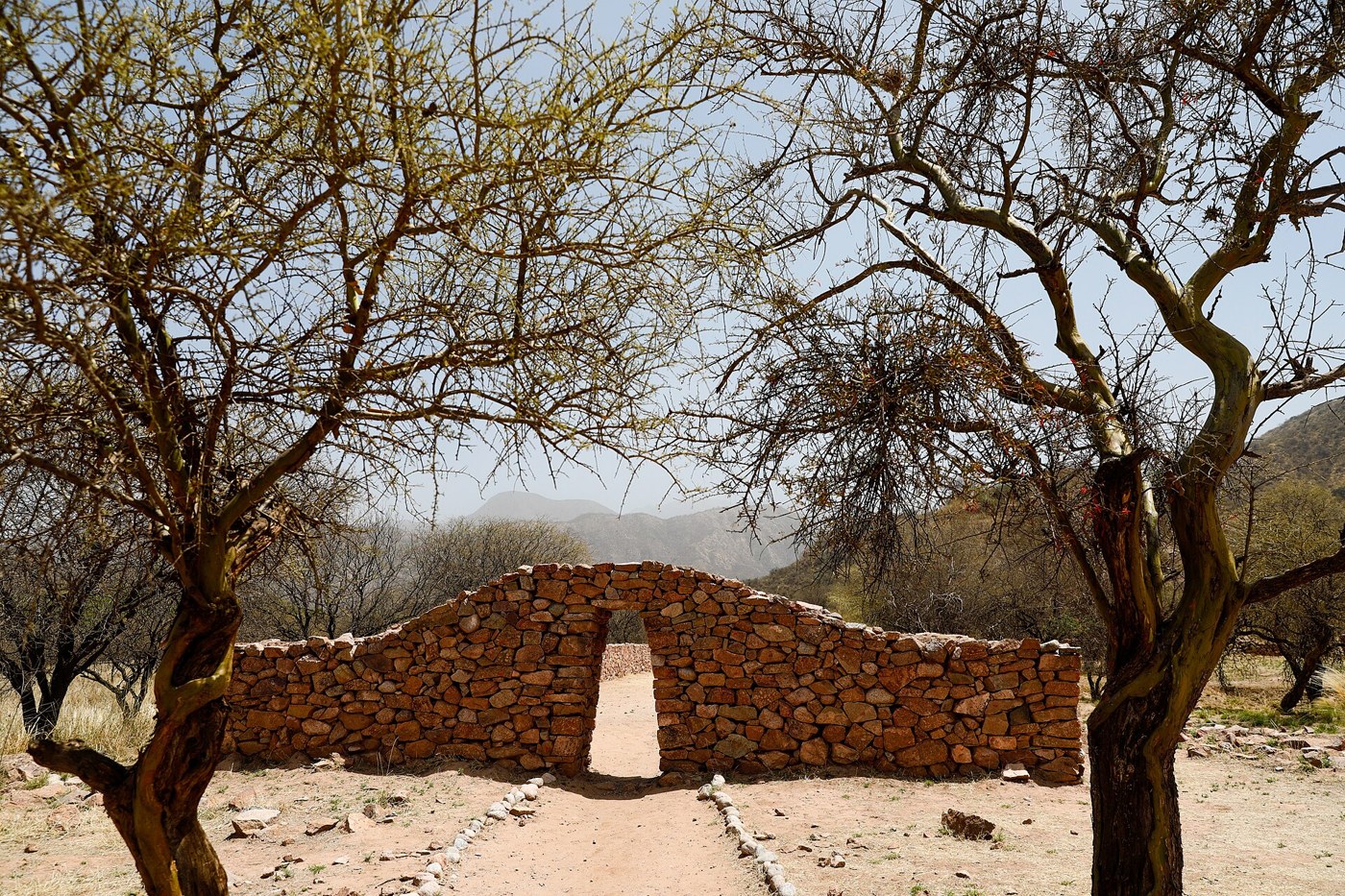

El Shincal de Quimivil, near Londres in Catamarca, makes more sense when you examine relationships rather than count walls. Its interest lies in the arrangement of gathering spaces, enclosures, and structures associated with administration and ceremony. A useful starting question is simple: what changes when a settlement organizes activities across a region rather than serving only the people who live immediately around it?
Put the names on a plan
The national heritage description identifies a large plaza, a ceremonial platform called an ushnu, buildings known as kallankas, storage structures, and other remains. These terms help identify functions proposed through research, but they are best learned alongside a plan. Memorizing vocabulary without locating it on the ground misses the important relationships of scale, movement, and hierarchy among the parts.
Change the scale
Begin with an overall view from an authorized position. Compare the open space with surrounding enclosures and notice where entrances appear. Then select one area to examine more closely. Moving between these two scales prevents the visit from becoming a succession of unrelated stones. The wider landscape also belongs in the discussion: resources, routes, and water help explain a center connected with a territory.
A guide can explain the evidence supporting a particular interpretation. Asking how a storage area or ceremonial function was identified creates a more precise conversation than simply asking which structure is oldest. It is also useful to distinguish the Inca period from other occupations and changes. A place's history does not necessarily begin or end with the period that receives the most tourist attention.
Walking and remembering
An outdoor visit needs an appropriate pace. Before arriving, check current arrangements, path conditions, and whether the route can be adapted for anyone who needs to avoid stairs or slopes. Reaching every viewpoint is not necessary to understand the overall layout. Observe structures without leaning on their edges, and leave material where it lies even when it looks like an ordinary stone.
Afterward, sketch a simple version of what you remember: a plaza, two connections, and an area whose function interested you. The drawing does not need to be exact or usable for navigation. Its value is in checking whether you understood a spatial organization rather than collecting disconnected names. If the sketch exposes a question, you have a useful reason to return to the interpretation center's material and continue learning.