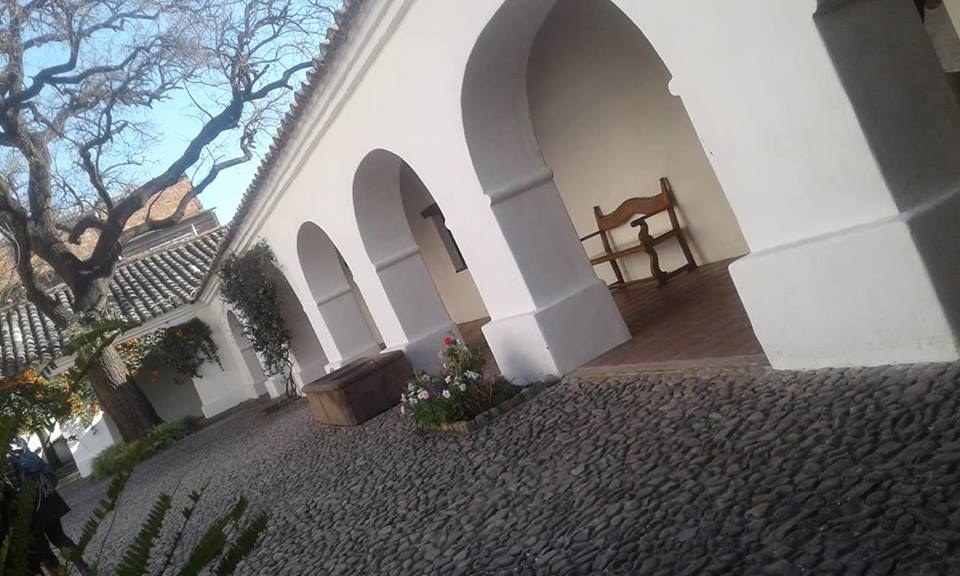

Facing Salta's central square, the Cabildo offers two things to examine at once. One is the building, whose galleries and courtyards organize your route. The other is the history assembled by the museum through objects, documents, and interpretation. They do not always belong to the same period. Keeping that distinction in mind lets you appreciate the architecture without confusing an object's display location with its original setting.
One complex, separate places
The Museo Histórico del Norte occupies the former Cabildo and belongs to a museum complex that also includes Casa Uriburu and Posta de Yatasto. These are not three adjoining galleries or a visit automatically completed under one set of arrangements. If another location interests you, check its address and visitor information separately. For an introductory visit, the Cabildo can be a complete and manageable focus in itself.
From courtyard to collection
Start by noticing the transition from street to courtyard. Shade, successive doorways, and covered galleries suggest how the building worked, although its uses changed. The institution's history describes alterations to the structure over time. A colonial appearance therefore does not mean every visible surface remains untouched from the colonial period. This distinction encourages curiosity about maintenance and adaptation rather than a search for an entirely frozen scene.
Inside, choose two apparently different objects and ask what connection the museum proposes between them. An administrative document and a piece of furniture might address authority at different scales. Note the date, material, and provenance before drawing a conclusion. When one of those details is missing, that absence also limits what a visitor can reasonably claim about the object.
Read the wording of labels carefully. “Attributed to,” “from,” and “used by” describe different relationships with the past. A manufacturing date is not necessarily the date an item entered the collection. Slower reading prevents everything from becoming a generic illustration of old-fashioned life. It also makes curatorial choices visible: what is grouped together, what receives emphasis, and what is absent from the narrative.
Looking back at the square
There is no need to approach the museum as an endurance test. With limited time, follow a coherent selection and leave room to return to the courtyard or ask staff a question. Before leaving, compare the building's scale with the square across the street. The visit becomes richer when the Cabildo is understood as more than an isolated monument: it can be a way to consider the relationships among urban space, authority, and public memory.