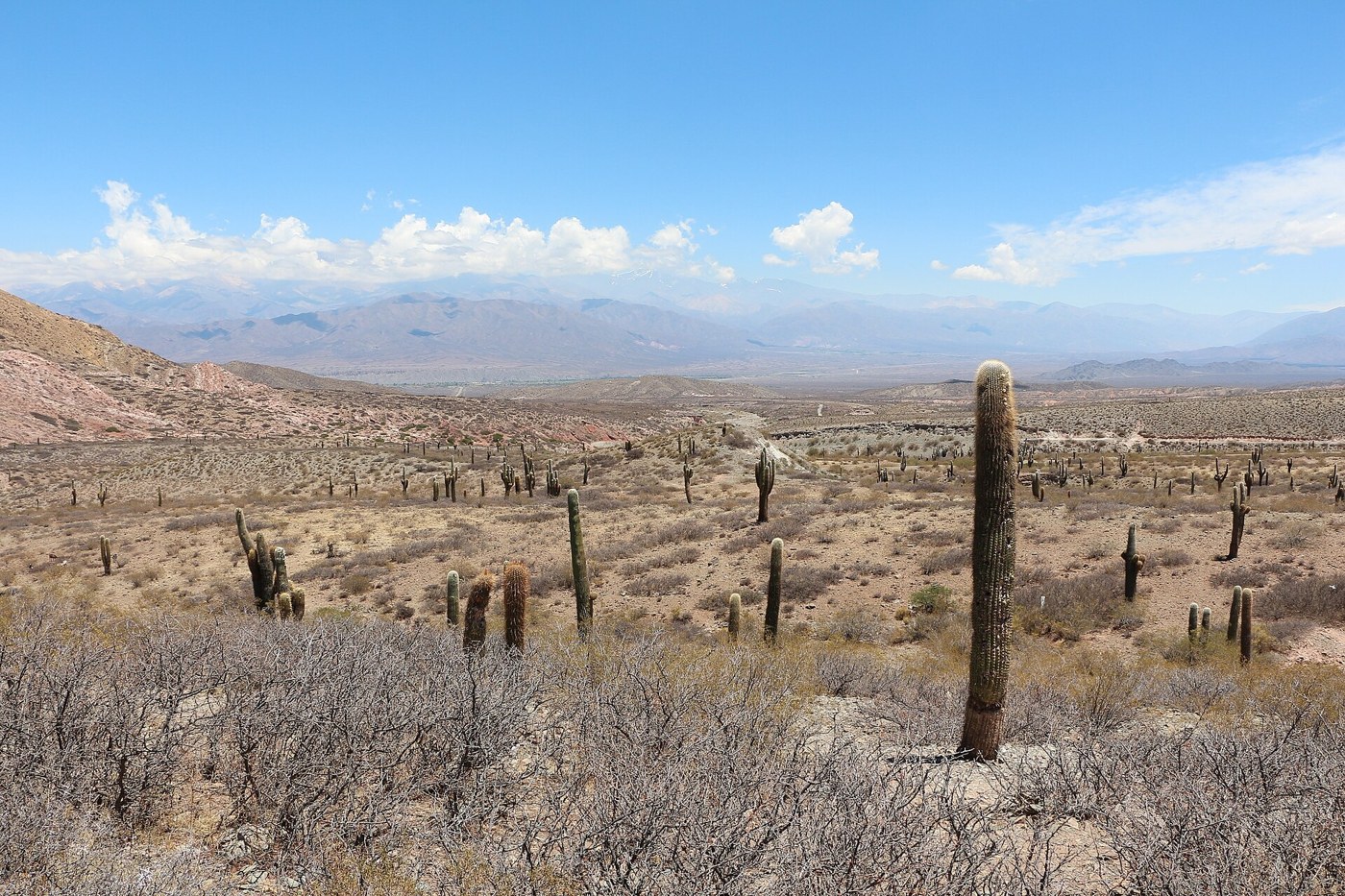

The silhouettes of tall cacti make the park recognizable before its name is known. Yet a view of repeated cactus forms stretching toward the horizon can conceal less obvious diversity. Los Cardones in Salta protects mountain environments, dry sectors, and areas associated with cloud grasslands. Seeing it as a mosaic helps explain why the vegetation does not all look alike or occur in a uniform pattern.
The plant that names the landscape
National Parks information identifies the cardón, or pasacana, as Trichocereus pasacana. Its tree-like form makes it conspicuous in broad views, but the park also contains other cacti. Calling every roadside cactus a cardón can therefore erase interesting differences.
From an authorized trail, compare sizes, shapes, and the spacing between plants. A tall specimen does not reveal a precise age by itself, and an absence of flowers during one visit does not mean it never flowers. Record what you observe before seeking an explanation. A well-formed question is more useful than quickly assigning a category.
Water changes the pattern
The park's biodiversity account includes highland wet meadows and areas of churqui trees associated with water availability. These are reminders that an arid environment is not a place without water, but one where its presence and distribution are especially influential.
When noticing a greener area, ask whether it occupies a depression, follows a watercourse, or contrasts with a slope. You do not need to approach a fragile area to recognize that pattern. A simple sketch from an authorized viewpoint can reveal relationships omitted by a close photograph of a cactus.
Relationships that are not always visible
The park's study material explains the importance of relationships between plants and animals, including pollination by birds and insects. Conservation is not limited to maintaining large, photogenic specimens. It also protects processes and less conspicuous organisms.
Do not turn a wildlife list into a promise of sightings. An animal can occur in the area without appearing during your visit. Spending a few quiet minutes at a distance, without offering food, allows observation without deliberately changing what happens. Even without a sighting, the landscape continues to offer information.
Leave the place intact
Choose trails and viewpoints according to current conditions and the group's needs. Mountain activities and a short interpretive stop make different demands. Consult park guidance before deciding and remain within authorized visitor areas.
Do not remove wood, stones, seeds, or remains that appear abandoned. The history of cactus use does not authorize collecting it today. A useful memory can be a new observation about water, a plant's shape, or the valley's scale without taking a piece of the place away.