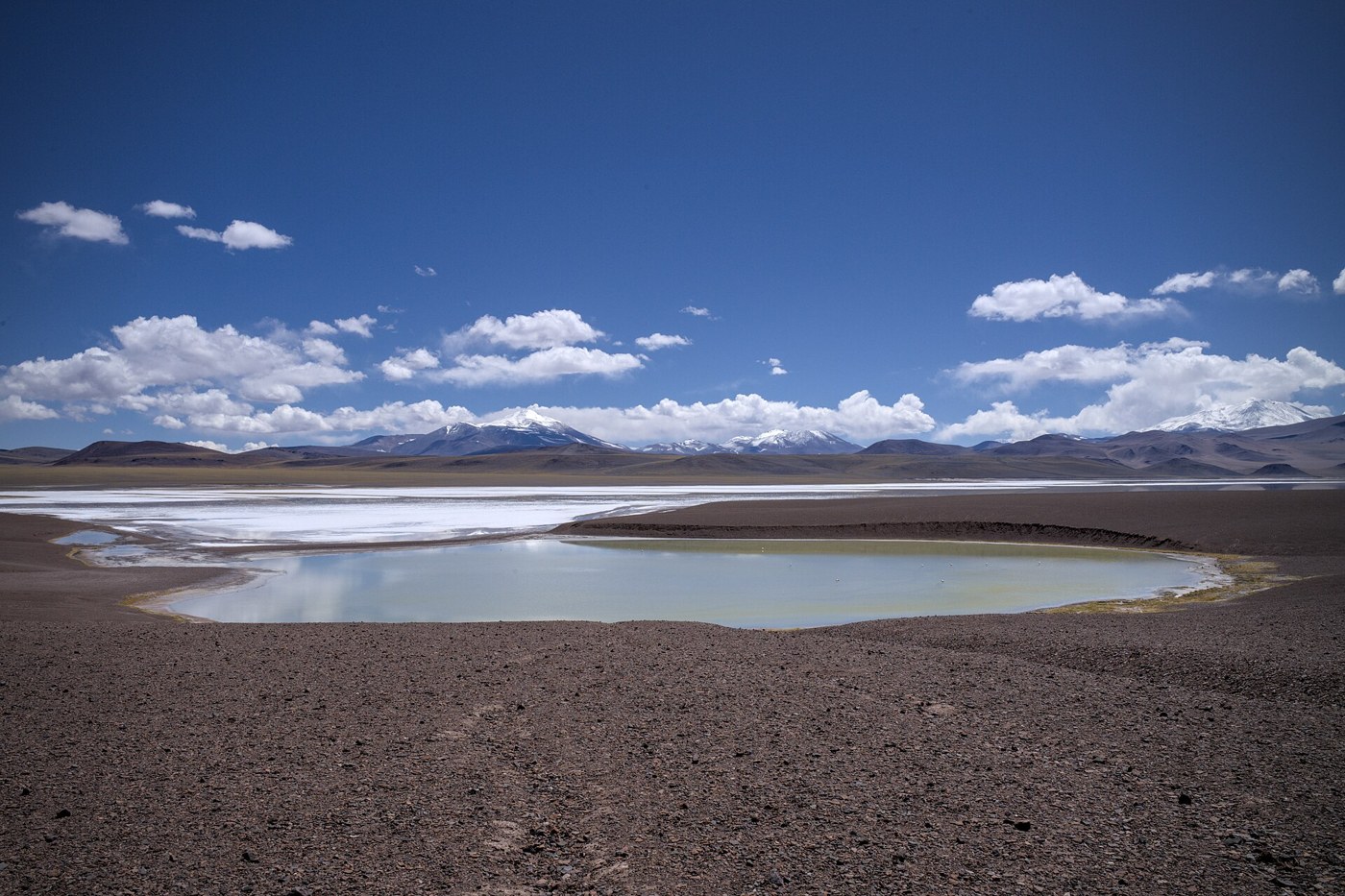

Distance is not the only useful measure when planning an excursion to Laguna Brava. Elevation, the day's conditions, time inside the vehicle, and opportunities to stop also matter. A remote outing may look short when reduced to a line on a map yet operate very differently on the ground. Before adding attractions to the program, establish how much of the day will involve transportation and how much will be available for observing the wetland itself.
Reading the whole wetland
The La Rioja reserve protects a collection of high Andean environments, rather than a single patch of water. Its Ramsar description identifies shallow saline and hypersaline lakes with associated wet meadows and other wetlands. This combination helps explain why an apparently dry setting contains important places for waterbirds. Visible water and wet vegetation are not isolated details: they guide a reading of the landscape in which different environments serve different functions. The wider setting matters alongside the lake that gives the excursion its name.
At an authorized stop, begin with a broad view. Compare the water, pale exposed surfaces, and bands of vegetation without assuming that every white area has the same origin or composition. A visitor can recognize contrasts through observation; identifying salts or reconstructing water chemistry requires other methods. If a guide explains a process, ask what evidence supports it and what might vary with conditions. This preserves the landscape's complexity without requiring a complete technical lecture at every stop.
Observing without demanding sightings
Birds should not become a promise attached to the reserve either. Environmental sources record high Andean flamingos and other wildlife, but their distribution and visibility cannot be fixed for a travel date. Arrive expecting to observe rather than demanding a particular scene. Watching from a distance may reveal how birds use different parts of the shore; approaching for a portrait may interrupt that behavior. A day with few visible animals can still explain a great deal about the wetland's structure.
What to confirm with the operator
Provincial tourism information specifies visits with authorized guides and suitable four-wheel-drive vehicles. Check the provider's authorization and request the actual program rather than relying on its commercial name. Ask about the meeting point, included transportation, cancellation conditions, and how changes are decided if the weather shifts. A confirmed reservation does not make a remote environment independent of the weather. Understanding the operator's decision process is part of understanding the excursion you are buying.
Elevation deserves a specific conversation before booking. Explain any mobility limitations and ask about walking, planned time at altitude, and the possibility of returning early. If you have personal health concerns, discuss them with a qualified professional; an excursion description cannot assess your circumstances. Avoid placing an inflexible commitment immediately after the expected return. Flexibility is not wasted time when the program depends on variable conditions, and it can make changes easier to manage for everyone involved.
A clear expectation
Finally, decide what you hope to gain from the day: an understanding of the wetland, landscape photographs, or an introduction to high Andean environments. That focus helps compare programs that share a name but offer different experiences. Save observations with their date and context, leave all natural materials in place, and accept the limits explained by your guide. Adjusting the itinerary may be a better decision than trying to complete an attraction list at any cost.