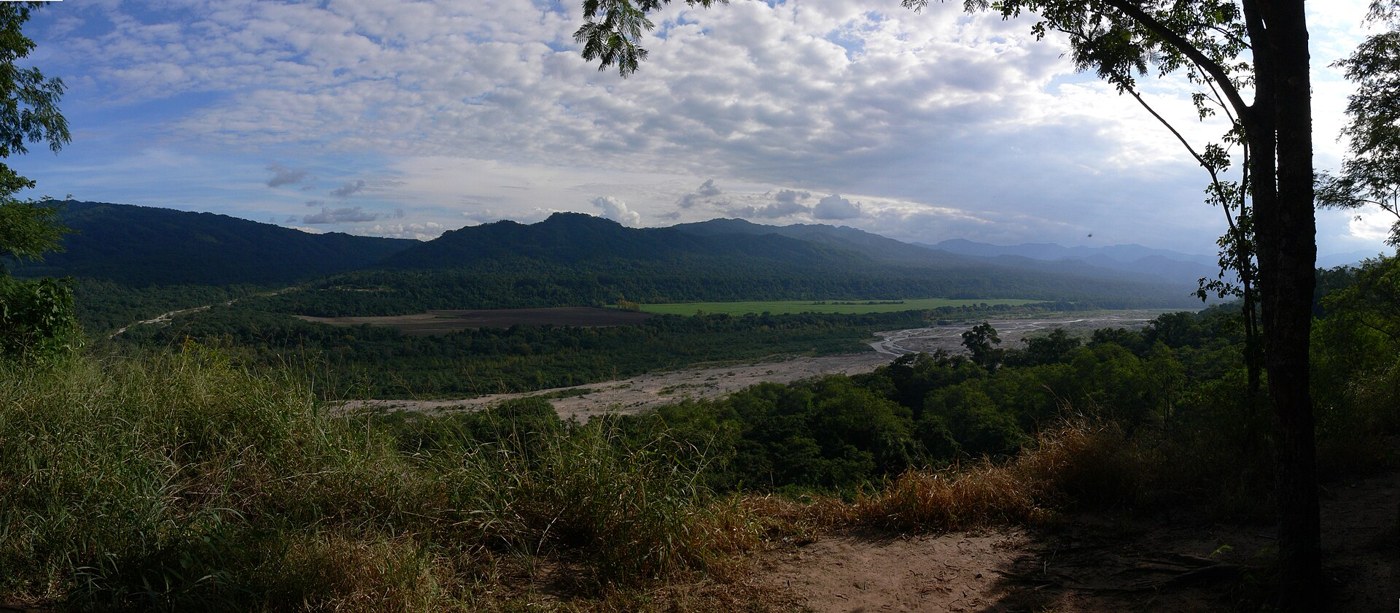

Calilegua offers access to the Yungas of Jujuy through outings with different purposes. An interpretive trail, a birdwatching session, and an ascent along the provincial road are not equivalent versions of one activity. Each reveals a different scale of the forest and requires different arrangements. For a first visit, choosing something you genuinely want to understand usually works better than trying to cover every area mentioned in a guide. The whole park does not need to be seen for a day to have substance and variety.
Two scales of forest
Provincial Route 83 crosses the protected area and reveals changes in vegetation as it climbs. Observing from a vehicle helps place the forest within the terrain, but it does not replace walking. On foot, details emerge that are easily missed from the road: layers of leaves, plants growing on other plants, and sounds with no immediately obvious source. Combining both scales is useful as long as they are not confused. The road also carries traffic, so stops must respect other users and take place only in appropriate authorized areas.
The choice begins with information
Aguas Negras is a reference point for visitor information. The official activities page requires advance registration for hiking and distinguishes routes by difficulty and season. Do not choose by distance alone: a short section may include gradients or conditions that require time, and some circuits close in summer. Ask for an option that suits the whole group and establish the required return time. With that information, a shorter walk can leave room for observation rather than obliging everyone to maintain a continuous pace simply to finish the route.
Cultural interpretation without simplification
The Nuestra Selva trail incorporates Guaraní symbolic interpretation. Its interest lies in presenting a cultural relationship with the environment rather than only an inventory of trees. Reading or hearing that interpretation does not justify extending it to every Indigenous people or presenting a culture as unchanging. To explore the subject beyond the park, ask about experiences organized by communities themselves or local institutions. An interpretive walk can open questions; it does not turn a brief visit into complete knowledge about other people's lives, beliefs, or contemporary circumstances.
Observing without demanding appearances
For birdwatching, binoculars and patience are often more useful than constantly moving between locations. Choose a place where you can pause without obstructing the trail and record what you actually saw, distinguishing it from sounds or uncertain identifications. Park species lists describe diversity, not a scheduled sequence of appearances. Avoid attracting animals with food or recorded calls. Plants and fungi can also hold your attention while you wait, without touching or removing organisms to examine them elsewhere. Observation does not require controlling what appears in front of you.
Facilities for a well-organized day
The day works better when water, food, and transportation are arranged before entry. Official information distinguishes water for hygiene from drinking water in recreation areas; do not assume every tap is suitable for refilling a bottle. Check current facilities and bring what the chosen outing requires. Calilegua offers an opportunity to connect elevation, forest, and culture when the plan leaves room for those observations. A worthwhile visit is measured less by the number of completed trails than by what you learned to recognize without rushing the walk or disturbing the environment.